
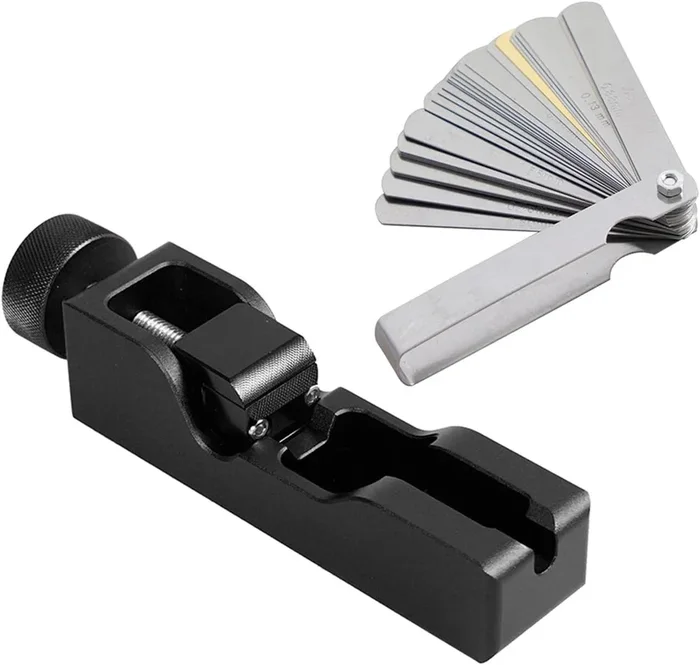
Description
NOTE the item is red
Easily adjust the gap with this spark plug tool
Fits the following spark plugs: 10/12/14/16mm (DOES NOT fit 18mm spark plugs)
Which gap is best?
The exact spark plug gap (electrode gap) depends on the engine design, the strength of the ignition system and how much power the engine produces.
- Original engines: Usually 0.7–1.1 mm depending on the engine model and manufacturer’s specification.
- Trimmed engines / turbo engines: Often smaller gaps, e.g. 0.6–0.7 mm, to reduce the risk of spark blowout under high boost pressure.
- E85 or methanol fuel: The ignition system often has to work harder – sometimes even tighter gaps are needed, e.g. 0.5–0.6 mm, if the spark has difficulty igniting the mixture.
Advantages of tighter spark plug gaps
- Less risk of spark blowout under high boost pressure
In engines with high cylinder pressure (e.g. turbo or supercharger), a large gap can cause the spark to “blow out”. A smaller gap is more stable under these conditions. - Lower voltage requirements from the ignition system
Shorter spark gaps require less voltage to ignite → reduces the risk of misfires, especially if coils or ignition modules are close to the limit. - More stable spark under full load / high rpm
During hard driving or high rpm, combustion conditions are more difficult, and a tighter gap provides a more reliable spark. - Better adaptation to ethanol (E85) and methanol
These fuels are more difficult to ignite, and tighter gaps help the ignition cope with the thicker fuel-air mixture. - Less stress on ignition wires and insulation
Since the voltage is lower, the risk of flashover or electrical leakage is reduced.
Disadvantages of tighter spark plug gaps
- Weaker spark at low rpm or cold start
A smaller gap gives a shorter spark, which can lead to poorer ignition at cold start or low rpm, especially in cold climates or with weaker ignition systems. - Poorer fuel efficiency during normal driving
The shorter spark can give poorer combustion when the engine is not under load → slightly worse economy and more emissions. - Misfire / uneven running when cruising
If the gap is too small, the engine can run dirty or have uneven running at light throttle, since the fuel-air mixture is not always ignited optimally. - Less forgiving of bad ignition components
A tight gap often requires that the coil, cables and ignition module is in good condition. Worn parts or low voltage can quickly cause problems.
Table
Here is a general list that you can use to compare against.
NOTE no recommendation, use only as a guide
| Engine trim | Rec. heat index | Approximate gap |
|---|---|---|
| Original | Standard (ex. NGK BKR6E) | 0.8–1.0 mm |
| Lightly tuned | 1 step cooler | 0.7–0.8 mm |
| Heavy tuned / Turbo | 1–2 steps cooler | 0.5–0.7 mm |
| E85/methanol | 1–2 steps cooler | 0.5–0.6 mm |
—————-
Guides & Info

Reviews
There are no reviews yet.